

Insights from a Visiting Librarian: An Erasmus+ Experience at the Catholic University
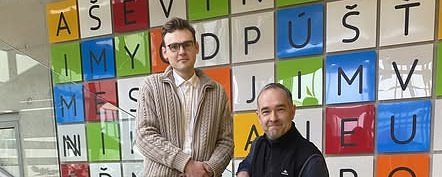
Erasmus+ has long been one of the strongest pillars of academic mobility at the Catholic University in Ružomberok (CU). It opens doors for students, academics, and administrative staff to gain professional, linguistic, and cultural experience abroad, while at the same time CU provides opportunities for professional development to incoming international students and colleagues. Within the Erasmus+ KA131 mobility scheme, the university annually welcomes more than 20% of international staff in proportion to its total number of employees. Among them is Mark Zujevs, whose training further enriched the international dimension of our academic environment.
Could you please introduce the Riga Higher Institute of Religious Sciences and its connection to the Pontifical Lateran University?
The Riga Higher Institute of Religious Sciences (RARZI) is a Catholic higher education institution based in Riga, Latvia. Its mission is to provide high‑quality education in Catholic theology and its pastoral applications. The Institute offers bachelor’s and master’s programmes, as well as a one‑year professional programme. RARZI is unique in the Latvian educational landscape, as it is the only institution in the country where laypeople can obtain Catholic higher education. Another distinguishing feature is its affiliation with the Pontifical Lateran University in Rome. This affiliation ensures that our institution adheres to the core guidelines and standards set for pontifical Catholic universities and expresses our doctrinal and spiritual communion with Rome. Upon graduation, students have the opportunity to receive two diplomas (one issued in Rome).
You work in the university library. What are your main responsibilities?
My main responsibility is to support our students in all matters related to the library. This includes assisting readers in finding appropriate materials for their studies, helping them use available information resources, and providing guidance on the formal requirements of the academic research they undertake.
This is your first mobility within the Erasmus+ programme. We are pleased that you chose the Catholic University. What motivated you to participate?
My primary motivation for participating in Erasmus mobility was the opportunity to broaden my horizons in both professional and cultural aspects. I have visited several Latvian libraries multiple times, and although it was a valuable experience, I felt that it had its limitations. In Latvia, we have certain mechanisms, curricula, and traditions concerning how library work should be done. In general, these practices are good and well‑thought‑out, but given the uniqueness of our institution, they do not always meet our needs. Therefore, I wanted to see how things are done at another Catholic university in a different cultural context.
During your mobility, you had the opportunity to compare digital resources. How do you perceive the differences between Latvia and Slovakia (or at least between our two universities) in terms of digital library services?
It appears that when it comes to digital resources, both countries have well‑functioning systems that universities and other institutions can successfully use. In Latvia, all major library‑related matters are coordinated by the National Library of Latvia. The library provides its regular users with two very valuable services. The first is a digital collection of books and newspapers – https://gramatas.lndb.lv/. It is a database containing a large number of older materials that are freely accessible online. Many entries offer full‑text search and the possibility to download documents directly. The second service is remote access to major local and international databases such as EBSCO, JSTOR, Cambridge Journals Online and others, free of charge. A potential user must register with the library, complete a provided form, and request a password. If I understand correctly, many aspects of library work in Slovakia are also centralized. The Slovak National Library offers a similar collection of freely accessible resources, as well as access to certain databases for registered users. The main difference I observed is that universities in Slovakia can obtain access to some paid databases, whereas in Latvia this option is granted only to individual users, not academic institutions.
Which specific activities during your mobility at the Catholic University in Ružomberok did you find most enriching for your professional development?
I believe the most enriching part was the time spent with each of the CU experts who showed me how they perform their particular duties. I also appreciated the detailed tour of the facilities, as it helped me understand the functioning of your library in all its complexity.
Which experiences or solutions from CU would you like to implement in your library in Riga after returning home?
There is one thing I would like to try implementing in our library. It concerns book shelving practices. I liked the labelling system used at CU (in fact, I had never seen such a system before!) — the label placed on the book spine includes only the category code to which the book belongs and its sequential number within that category. This differs from what I have seen in Latvian libraries, where labels usually include additional information such as UDC numbers, author surnames, book location, etc. From what I have observed, books in Latvia are usually not placed according to sequential numbers; instead, they are sorted by author surname or by language. The advantage of the system used at CU is that book sorting is faster and more efficient — it simplifies the process of placing new acquisitions on the shelves.
What would you recommend to those who are considering participating in Erasmus+ but still hesitate?
I would tell them that the only way to truly understand what Erasmus mobility offers is to try it! On the one hand, it is very good (and certainly necessary) to prepare a plan or schedule for the visit, and one must be ready to put effort into the entire process. On the other hand, it is also important to remain open to opportunities that can be discovered only on site, and to treat the free time available in the host country as a meaningful part of the learning experience. My advice would be not to overcomplicate the decision-making process — if the circumstances align and such an opportunity arises, simply take advantage of this valuable offer and see what it brings you.
Michaela Moldová Chovancová thanks you for the interview
Photography: CU Library