

Representatives of the Catholic University Participated in an Erasmus+ BIP on Environmental Sustainability
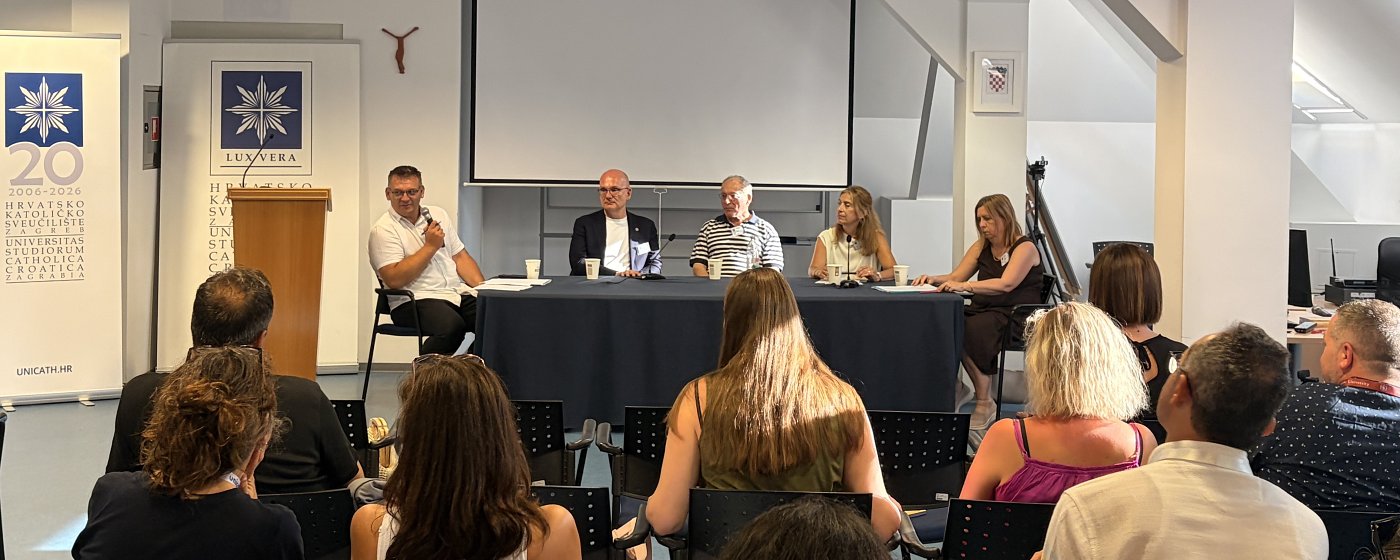
More than 30 participants from nine countries - Portugal, Spain, Slovakia, Austria, Türkiye, Ireland, Netherland, Romania, and Croatia - took part in the Erasmus+ Blended Intensive Programme (BIP). The Catholic University in Ružomberok was represented by Mgr. Lucia Kravčáková, Mgr. Lenka Horváthová, and PaedDr. ThLic. Martin Pinkoš, PhD.
The programme was organized by the Catholic University of Croatia in cooperation with the Laudato Si’ University Centre for Christian Responsibility and Care for All Creation. Its main focus was the role of higher education institutions in advancing one of the Erasmus+ horizontal priorities: environmental protection and the fight against climate change.
The programme was officially opened by Prof. Ante Crnčević, Vice-Rector for Quality, Identity, and Mission at the Catholic University of Croatia, who emphasized the importance of international cooperation and the exchange of experience in the fields of sustainability and climate action.
The opening session was followed by the panel discussion "Climate Action in Higher Education: Institutional Responsibilities and Project Opportunities." Panelists discussed the responsibility of higher education institutions in promoting sustainability, implementing green policies, and developing environmentally oriented projects. Particular attention was given to cooperation between academia, public institutions, and international partners.
Throughout the programme, participants explored various aspects of climate and environmental responsibility through expert lectures and practical workshops. Discussions addressed the current state of climate change, European climate and energy policy, and the need to engage individuals, institutions, and society as a whole in the ecological transition.
One of the key topics was the whole-institution approach to environmental sustainability at universities. This approach emphasizes that environmental principles should not be confined to individual courses or projects but should instead be integrated into the university's strategic management, teaching and learning, research, campus operations, mobility, public procurement, and engagement with local communities.
The programme also focused on green and circular public procurement. Participants discussed how responsible consumption begins not with waste sorting and recycling, but at the stage of selecting and purchasing products and services with sustainability in mind.
Another part of the programme provided practical guidance on incorporating European, national, and regional environmental and sustainability policy documents into project proposals. Participants gained valuable insights into formulating project objectives, activities, indicators, and expected outcomes in line with sustainability priorities.
The participation of the Catholic University's representatives brought valuable new knowledge and examples of good practice that can support the university's efforts in environmental responsibility, internationalization, and project development. The programme also created opportunities to exchange experiences with international partners and to establish contacts for future cooperation.
The knowledge and inspiration gained can be applied particularly in the preparation of Erasmus+ projects, the promotion of sustainable mobility, the implementation of responsible consumption principles, and the integration of education, research, and institutional governance. Within the context of a Catholic university, these initiatives are also closely linked to the principles of integral ecology and the responsibility to care for our common home, as emphasized in Pope Francis' encyclical Laudato Si'.